


False cognates, or false friends, are pairs of Spanish and English words that look alike but do not share meanings. For Colombian professionals, they create confusion in emails, meetings, and client calls. This list covers eight common ones, the Colombian interference pattern behind each, and the correct phrase in English. Berlitz counts over 150 such pairs between the two languages.
1. “Actually” no significa “actualmente”
The Spanish adverb “actualmente” means “currently” or “at present”, not “”. A Colombian professional writes “We are working on it” to mean “right now”—the American reader hears “in fact, contrary to what you said”. In a client email, “We are processing your order” sounds like a correction, not a status update.
The correct translation for “actualmente” is “currently”: “We are currently processing your order”. Berlitz highlights actual and actualmente among the most common Spanish-English false cognates.
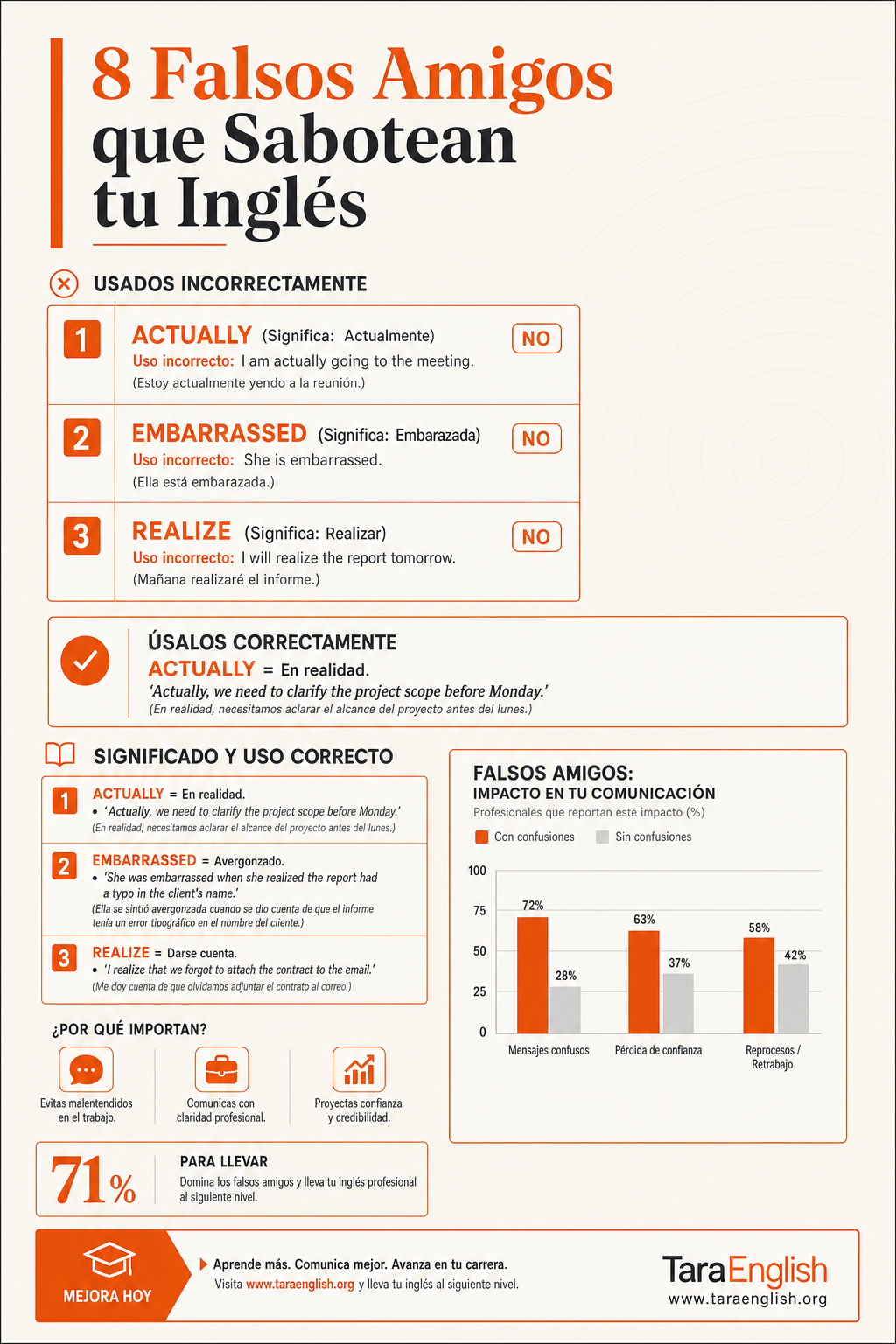
2. “Embarrassed” no significa “embarazada”
 El falso cognado embarazada significa embarazo y no vergüenza, lo que genera malentendidos laborales. — Foto de Andrea Piacquadio en Pexels
The Spanish word “embarazada” means “pregnant”, while “embarrassed” means “avergonzado”. A Colombian employee once told a US manager “I am embarrassed to come to work”—the manager understood a pregnancy announcement.
Workplace impact: misusing this word in a serious conversation creates immediate confusion or an awkward silence. The correct word for “avergonzado” is “embarrassed” or, more formally, “ashamed”. SpanishDict lists embarazada as a classic example in its false cognate guide.
3. “Realizar” no es “to realize”
 El verbo realizar se traduce mejor como llevar a cabo o ejecutar para evitar confusiones en inglés. — Foto de Startup Stock Photos en Pexels
The Spanish verb “realizar” means “to do, carry out, or perform”, not “to realize”. A Colombian writes “We realize the project next week”—the American reader expects a sudden insight, not a project plan. The correct English verb for “realizar” depends on context: “carry out”, “perform”, or “do”.
In a project update, “We will carry out the testing by Friday” replaces “We will realize the testing by Friday”. Berlitz includes realizar in its list of 150 false cognates with the correct English equivalents.
4. “Sensible” no es “sensible”
The Spanish word “sensible” means “sensitive” or “susceptible”, not “sensible” in English. A Colombian says “She is sensible about feedback”—the American hears “level-headed”, not “easily affected”. Workplace impact: performance reviews become confusing when everyone speaks a different meaning of “sensible”.
The English word “sensible” means “practical and reasonable”; the Spanish meaning maps to “sensitive”. SpanishDict places “sensible” among the false cognates that cause frequent misunderstandings in conversations.
5. “Introducir” no es “to introduce”
The Spanish verb “introducir” means “to insert” or “to put in”, not “to introduce a person”. A Colombian in a meeting says “ introduce the new software”—the American hears inserting the software, not presenting it. The confusion disappears when you use “present” or “show”: “ present the new software”.
This mistake appears often in workplace presentations and product demos. Berlitz lists “introducir” as a false cognate and recommends “present” or “show” in English.
6. “Soportar” no es “to support”
The Spanish verb “soportar” means “to tolerate, endure, or bear”, not “to support” in English. A Colombian tells a colleague “I support your decisión” but means “I tolerate it”—a serious workplace miscommunication.
The English verb for support in a professional context is “support” or “back”, as in “I support your approach”. This false cognate can damage team morale when someone appears to reject a decisión. Berlitz’s list includes “soportar” as a false friend and clarifies the correct translation to “to support”.
Lo peor de todos: “carpeta” no es “carpet”
The Spanish word “carpeta” means “folder” (for documents), not “carpet” (floor covering). Workplace impact: document management becomes a comedy of errors in shared drives. The correct English word is “folder”: “Save the file in the project folder”.
SpanishDict emphasizes that this false cognate creates confusion in office settings because the Spanish word refers to workplace objects.
Por qué sucede esto: la traducción directa
Colombians translate word-by-word from Spanish, producing these false cognates in English. The pattern is strongest with words that share Latin roots, giving a false sense of equivalence. Berlitz reports that 150 common Spanish-English false cognates exist, but hundreds more appear in specific dialects and professions.
The most reliable method: check a dictionary before using a word that looks like its Spanish counterpart in a professional email. Context and practice with native speakers reduce the frequency of these errors over time.
FAQ
What are false cognates in Spanish and English?
False cognates, also called false friends, are words in two languages that look or sound alike but have different meanings. For example, the Spanish “actual” means “current”, not “real”. About 150 common false cognates appear between Spanish and English, and they cause frequent mistakes in professional communication.
How do I avoid mistakes with false friends at work?
The most reliable strategy is to double-check any word that looks like its Spanish equivalent before using it in an email or meeting. Learn the word in its English context, practice with native speakers, and ask when unsure. Berlitz recommends these steps in its guide to false cognates.
What is the difference between a cognate and a false cognate?
A true cognate is a word pair that shares meaning and origin, like “hospital” in both languages. A false cognate, also called a false friend, looks similar but has a different meaning. For example, the Spanish “embarazada” and English “embarrassed” look alike but mean completely different things, leading to workplace misunderstandings.
Are there false cognates that cause embarrassment in professional settings?
Yes, the most damaging ones involve sensitive topics like pregnancy and personal feelings. The word “embarazada” is the clearest example. In a performance review or team meeting, using “embarrassed” when you mean “pregnant” creates immediate confusion and can derail the conversation entirely.
How many false cognates exist between Spanish and English?
Berlitz lists 150 common false cognates, but the actual number is higher when considering regional variations and technical fields. The count grows when you include words from specific industries like law, medicine, and IT. For a professional, focusing on the 30 or 40 most frequent ones is enough to prevent serious mistakes.